I'm frequently nostalgic. Usually it's about a girl. Every now and then I get a bit obsessed about things from my past, and, as if to satisfy a tiny wee voice inside me, I hit the google machine and look for evidence that I did actually exist "back then". Sometimes my memory tricks me. Sometimes - quite frequently actually - I think did that really happen? So it feels good to see some old photographs, or faded letters, or (in these modern times) to see proof-positive on the Internet that my memory does indeed serve me well (most of the time).
So it was the other night when I got to thinking about my old dancing teacher, Irene Oliver. I remember Irene was well over a hundred years old when she was teaching in the 70s. Well, she seemed to be well over a hundred (I was a teenager so anybody over 30 seemed ancient), but in reality she must have been in her 60s or even 70s. And I've often wondered over the years if she has died, and when. But equally it wouldn't surprise me if she were still alive and is actually now well over a hundred. She lived for two things, as I remember. Dancing, and caring for her elderly mother. Probably in that order. But it goes to show that longevity is in Irene's genes.
Monday, January 02, 2012


Monday, December 19, 2011
"How can this be?"

According to Scripture, Mary was surprised by the news she was with child. "Excuse me, Gabriel? I'm what?"
So how far fetched is it to imagine she would take a pregnancy test just to get it clear in her mind and think O.M.G. It's true! (using whatever techniques they used in BC times to test for pregnancy. Now that bears some interesting speculation).
Saturday, December 17, 2011
Bah humbug!
 |
| Bah humbug! |
I know a lot of people just simply hate Christmas. I'm one of them. I know a lot of people tolerate Christmas because it's forced upon us, it's expected, and it's almost impossible to escape. I'm one of them, too.
And I know a lot of people HATE people like me. Whether they actually love Christmas, or just can't admit that they secretly hate it and don't like being reminded of that, a part of the expectation is that we put on a happy face, crank up the Royal Guardsmen, and gird our loins as we muscle our way through The Warehouse checking our list twice and crossing off names as we buy trinkets made by poor little Chinese children who probably don't even know what Christmas is! I wonder, though (if they do do Christmas) do those little Chinese children wake up on Christmas day, open their presents and go "Hey! I made that!"?
Monday, November 28, 2011
The Political Machine

Believe it or not, I try to stay away from politics. I have an opinion, but mostly I have no idea. I have no idea about the machinations of Parliament, about the nuances of economies, about the cut and thrust of an election campaign, about the deals that may or may not go on behind closed doors.
Mostly I know how it is to live day to day with the price of everyday goods going up while wages increase at a vastly disproportionate rate (if at all). I know that three years ago we paid 99c for a loaf of Couplands bread and now, for what appears to be the same loaf of bread, we're paying $2.49. I know that at the same store we used to get two 2 litre bottles of milk for $4, and now it is $6.60. Cheese was $9 a kilo and went to nearly $15, but when obviously too many people couldn't afford it and stopped buying as much of it the price dropped again to $9. Now it's about $12. There was an uproar when petrol climbed towards $2 a litre and it dropped quickly; only to ever so quietly sneak up again so that now it's well over $2 and nobody is batting an eyelid. Two years ago we could get Josh a pair of shoes for twenty bucks. Now it's closer to thirty (and it's not just because his feet are bigger).
Friday, November 18, 2011
Shrine


It's interesting that at the end of Christchurch's newest shopping mall, the modified containers the whole world is talking about - well, arguing about - there is a fence, a kind of wall. It separates the new from the old.
This side of the fence is new and frivolous. Shoppers go about their business, happy to be able to shop in the CBD again. Just why the malls are inadequate I don't know, but for a certain set, shopping in the CBD seems to be more real, more honest.
On the other side of the fence is the old and somber, the dead and dying, the former Christchurch, characterised poignantly by the slow, but very visible (and loud, as one German tourist pointed out), deconstruction of the Hotel Grand Chancellor.
While shoppers, lunching workers and tourists happily go about their business in the containers slash boutiques and on the mall, many if not all (at some point) stand at the fence and look respectfully into the old Christchurch and take a moment.
It's kind of shrine like. I'd like to know what's in the minds of the worshippers. It's our own Wailing Wall. It's a stark reminder that, while the new and exciting slowly evolves behind us, there still exists the old world, the Christchurch that used to be, and that there is an impenetrable wall, physically and emotionally, between the two.
I've heard many people say that they grew up in Christchurch and down town represents for them their childhood. It's where they hung out as teenagers, it's where their parents (pre-mall) dragged them to buy shoes or to have family lunches.
I guess I might feel the same about Rotorua, even though with all due respect it wouldn't bother me if the entire city of Rotorua got swallowed by the volcano it's supposed to be sitting on. But that's another story. Good or (mostly) bad, I have memories of the city in which I grew up. I can still remember the streets and the shops, and if I dig deep enough I can probably recall the smells (not only the rotten-egg-sulphur smell) and the sounds unique to that city and my childhood. I remember the BNZ where my dad sometimes took me, and the Railway Station where he worked had very distinctive smells. Like the smell of jam sandwiches in a leather school bag, it's a smell that stays with you for a lifetime.
I guess it's the same for people who grew up in Christchurch. To see many of the buildings in the CBD crumbling must be touching something deep inside them.
Anyway, I think this Wailing Wall will attract more people, and many, like me, for whatever morbid or macabre reason will return to it many times and take a moment. Especially as the Grand Chancellor comes down floor by floor over the next twelve months or so.
Thursday, November 17, 2011
Coffee Zone
 If you're like a friend of mine, thinking "that wasn't there last week", you'd be right. It wasn't.
Coffee Zone is another example of the innovative, quirky establishment rising like a phoenix out of the liquifaction in Christchurch. From shipping container dairies or shopping malls and personalised portaloos, to pre-fabricated dance clubs and school classes, I thought I'd seen it all. Until yesterday.
I was driving through Sydenham and there it was. Like a wooden shack out the back of a swamp, Coffee Zone, al fresco cappuccino, seemed to have been banged together overnight and plonked on the nearest available empty lot. Of course, there are plenty of them in down town Sydenham.
Opposite the National Bank, on the old Eco Frame and Mirror space, Coffee Zone is...is really cool. It's been there a little over a week and it's open Monday to Friday, 730am til 330pm. You can text an order (0221409861) or call (03 3775725). Bex brews a good coffee and it's service with a smile.
And Lego.

I'm not sure what the Lego means. It's interwoven in the structure, but I'm pretty sure it meets earthquake code. It was inspired, says Bex the Barista, by something similar overseas, but whatever, it's funky.
 |
| Bex the Barista |

COFFEE ZONE
See you there.

Wednesday, October 19, 2011
Beyond Evolution
At the risk of being called obsessive – but lets face it, as you'll see I’ve been called worse – the evolution of the Boycott continues at a staggeringly dull pace, and I simply feel compelled to update those of you who may not give enough of a “monkey’s bumhole”, (a phrase carefully constructed by one of the Beyonders with an IQ slightly higher than the average on that page of 74) to go have a look.
And evolution might be the right word. As many believe that slugs crawled out of swamps, put clothes on and started calling themselves homo-sapiens, a similar dynamic has been taking place on the Beyond the Boycott page (whose principle members hijacked another Boycott page). Out from the swamp of hypocrisy and delusion, not a few slugs have crawled. They have put on the robes of judge, jury and executioner and called themselves righteous.
“Beyond” is a great epithet, too, because to the casual observer the members have indeed moved “Beyond” caring about the Kahui twins, if that ever was what they really cared about. Rarely are the twins mentioned. Now the hard core page members prefer to share stupid pictures with even stupider clichés printed on them, stolen, no doubt from the toilet walls of cyberspace; stroke each others egos with exclamations of praise when all they’ve done is managed to pull a few posts out of the SPAM folder or hurl particularly nasty abuse at Ian Wishart’s daughter; or giggle and hee hee at how clever they think they are because they only have “intelligent conversations” on their page.
It’s been a while since I’ve seen anything clever on either page that wasn’t written by a book supporter.
But apparently there are now grander issues to posture over. Like a few dead birds on the Bay of Plenty coast, or whatever other trendy outrage is circling Internet chatrooms.
And, of course, the favoured pastime of calling the book supporters' names continues. They have a special talent for vilifying the author of the book, Ian Wishart, but in their hypocrisy seem to ignore the fact that they are themselves guilty of the things they claim he has done. And the fact that he hasn’t actually done half of what they say he has makes them twice the children of hell they think he is.
Now, lest I be further accused of any bias, we book supporters continue to give what we get with the name-calling, finger-pointing and the giggling. But some have likened reading the Beyond pages to staring into a cage of monkeys at the zoo. It’s disgusting and it smells bad, but you just can’t help taunt the imbecilic creatures playing with their privates and staring blankly back at you.
And lest I be even further accused – as accusation is the hallmark of the paranoia that now seems to pervade nearly every thread on the Beyond pages…everyone’s facebook account is being hacked, threads and comments are being reported or sent to the spam folder, every profile is fake – of being one-sided and partial, let me dispel any speculation. Of course I am!! It’s my blog. Blogs like this are supposed to be one-sided and partial. I’d LOVE to see one of the Beyonders blogs. I’m sure it would be just as one-sided (unless it was some attempt at PC bullshit, as is common on the Beyond page). But I won’t hold my breath as most of them struggle to put full sentences and thoughts together. That’s my impression. But I have been told many times that my writing sucks. So, who knows.
Of course, some of them are handy with Google. It didn’t take them long to track my blog and websites down. Perhaps if I had known early on that I would be targeted by such nasty angry people, I would have done as many of them have done and set up a few fake profiles and pages, just to avoid having to deal with the threats and the attempts to have my blog shut down and the stalking and harassing behaviour some of them have exhibited. Oh well. Hindsight eh? Who knew there were unbalanced nasty people still allowed to live freely in society?
I was going to put up a whole string of screenshots of posts. There was some talk of the legality of such a thing, but I had a lovely chat with a lady at the Privacy Commission who assured me that, basically, if it’s in the public domain it’s fair game.
So I wasn’t really surprised when something from my personal Facebook wall turned up on the Beyond pages. For a while there seemed to be an unwritten rule that personal walls were off limits, but as with any war someone eventually gets around to breaking those rules in the hunt for whatever they can use to gain some advantage, even if it’s just to feel better about their sad, lonely lives.
Ironically, it was an “anonymous” page administrator (even though we all know who it is) that took one of my posts and circulated it round the Boycott pages. For all their crowing about fake and anonymous profiles, they sure have a few themselves. But hypocrisy and irony are generally lost on them as one rule for them but not us is the prevailing governing ideal.
 Anyway, I was going to put up another list of the most abusive posts, but I really couldn’t be bothered (there are so many). So I thought I’d concentrate on one thread, the one focussing on the quote pinched from my personal Facebook wall. It exhibits a slice of what we've had to deal with from time to time. They didn't like my personal belief and reacted angrily and nastily. The thing book supporters have been accused of time and time again.
 Hypocrisy much?
 |
| To be fair this comment seems to have been deleted. But that could only be because I reported it as abusive |


 |
| I apologise if this refers to someone else who should also be thrown into the oil slick |
Monday, October 17, 2011
Occupy Christchurch - The Beginning is Nigh
For a large part of my working life, I stood at a counter or sat at a desk earning (most recently) about 20 bucks an hour. In a lower-middle-class daze, I regularly pondered the reality that the CEO of the same company for which I toiled earned somewhere in the region of 2000 dollars an hour. And something about that just didn’t sit right.
 New Zealand is not immune to the global corporatisation that has a stranglehold on the average Kiwi. Chief protagonists are the banks, and those organisations that hold the global purse strings. Cash flows in abundance for 1% of the population, while the other 99% are faced daily with mortgagee sales, insurance claim bureaucracy (surely we in Christchurch understand that one), unemployment, sky-rocketing food prices, rising energy costs, increased government “levies” (a nice word for taxes), and tightening legislation restricting and/or compromising fundamental freedoms. The rich are getting richer, more often than not on the backs of the poor who are getting poorer.
Sure, it has to be said, he’s clearly a lot cleverer than me. He’s done the hard work, studying the right thing at University (business studies as opposed to my now-useless religious studies) and climbing the dog eat dog ladder in the corporate world. It’s those tenacious tendencies that get rewarded financially in this world. And surely one’s income is the most accurate standard by which we should judge our fellow human beings’ total value.
Isn’t it?
When I heard about the Occupy Wall Street movement, something resonated within me. I really had no idea what the details were; I simply heard that a bunch of people were pissed off about corporate “greed” and something long-buried in my psyche said “Right on!” And when I heard about its evolution in New Zealand, I thought I would at least give it a look.
The temptation was to dismiss the “movement” as one more tree-hugging, Greenpeace supporting, weed-smoking, dissent-loving, Leftist leaning commie uni-student special interest pressure group driven by the extreme liberal wimps in this, (in New Zealand) an election year.
But perhaps that might be a bit harsh. As protestor John Campbell (yep, that’s his name – and no relation) says “when you take a movement like this and try to describe it, you limit it.”
It’s all about freedom. Maybe that should be FREEDOM! “An ethereal concept,” according to Campbell. And that it is. Too big to deal with in one blog entry and how it applies to Occupy.
But our own Occupy movement is encamped in the corner of Hagley Park, opposite the hospital. They are there, according to Robert Read for “as long as it takes.” As long as what takes is a little more vague, however. But the principle on which the protest stands is sound. Something is wrong. As Read correctly points out, you know something is wrong when (sleepy, apathetic New Zealand) stands up to protest.
 |
| Freedom Fighters? John Campbell, Jesse, and Robert Read occupy Hagley Park |
It is glaringly obvious that the corporatisation of the global economy has left 99% of average Joes out in the cold (literally). Of course, it could be argued (as I have before) that that is how it’s been since the beginning of human endeavour. An elite few have subjugated the masses for their own profit. And those same elite few have manipulated the democratic, or any other political process to cement their positions.
But it can also be argued that never has it been so pervasive. It’s one thing to decry a landlord who dominated a few hundred peasants on a few hectares of land during the middle ages. It’s another thing when a modern international corporation has its fiscal fingers in a million pies including banking, insurance, core local services, and most dangerously government to the point that that same corporation can manipulate politicians and law-makers to satisfy its own greedy intentions, controlling literally millions of people world-wide, forcing them into poverty so its directors can live lives of luxury and excess.
Something is indeed wrong, but that something has always been wrong. Things have been changing in a pattern of social punctuated equilibrium. Is NOW the time for another level of change?
And then there’s the “media”? In the beginning of the Occupy movements there were media blackouts. Robert Read would like to think it’s not true, but just how under the corporate thumb the mainstream media is is blatantly obvious, and it’s certainly not a large step to make correlations between the two. The “media” has abandoned its fourth state ideals and bought into the “greed is good” mantra. Sure, they still crow about their important role in international affairs, and of course they get it right sometimes. But is their bias counter-intuitive? The mainstream media is now as much or more about making money than actually reporting the news (truthfully).
Stuff.co.nz reported 30 people making a stand in Christchurch. THIRTY? What hack reported that? Did they drive past Hagley Park at speed as the event was setting up and do a quick count? Did they not go back later and check out the march on which at least 300 people walked through the Park and down Riccarton Road?
30 indeed! Is that the level of accuracy the media thinks is appropriate for a movement that is determined to bring down its financial friends? Isn’t it then only another small step to suggest a deliberate campaign of misinformation so the public (who generally believes everything they read in the newspaper) underestimates the importance of the movement?
Sure, even 300 is only a very small percentage of the population of Christchurch. But to suggest it was 30 is insulting and not a little disingenuous. The number of toots received while on the march might suggest that there are more supporters in the general population that don’t have the time or the inclination to make a more committed stand, but at least appear to support the principle.
So it’s understood that “the media” is in fact one of the largest global corporations, and it stands to reason it would not want to report truthfully on a movement designed to bring down large global corporations.
So what difference can a rag-tag gathering of dissidents camping out in Hagley Park make? Maybe none. Maybe a little. Maybe a lot.
“I’m looking to events overseas,” says Campbell.
It’s clear that the Occupy movements overseas are getting attention. The media, who love violence and conflict more than truth or human interest cannot ignore the riots in Rome, or, now, the demonstrations in London, New York, San Fransisco, Sydney, Hong Kong or Auckland (even if The Press can largely ignore Occupy Christchurch – until some violence happens or one of the protesters is caught with some weed).
And neither can Campbell.

Exorbitant salaries for the elite few, and massive profits by global organisations that have reneged on their trickle-down promises can only be described as corruption of the worst kind.
And don’t forget just how deeply in the pockets of the corporates are many (most?) western governments. Sure they need corporate money, but at what price? Freedom? Democracy? Truth? Such things matter little to the people who define them (the 1%), but to the 99% they mean everything, and aren’t governments supposed to be of and for everyone, not just their favoured few?
So the rag-tag gathering in Hagley Park that is there “for as long as it takes” is doing us all a service. They are representing every Joe who ever got screwed by the government, an insurance company, a bank, an employer or anybody else with ties to the global plutocracy. Instead of telling them they are not wanted in Christchurch (as many of the commenters on the Stuff article/s have done), we should at least be encouraging them, if not joining them in their community (more on community next post).
Sunday, October 09, 2011
4 Things I Learned in a Cult
I think it's a hoot that recently I was flippantly accused of belonging to a cult, a cult of personality. Which is a bit ironic because I was involved in organised religion, the biggest cult of all, for 20 years. But for a couple of years, I was associated with an actual cult (one that most would recognise as such, as opposed to the more subtle [but more dangerous?] cultness of all religions).
There are many cults, and as many types of cults. By and large, reasonably intelligent, self-aware people know what a cult is and can recognise the characteristics of one long before they get caught up in it. Which is why cults mostly prey on the vulnerable and those desperately seeking something "the world" cannot provide.
I do, however, have a lot of respect for the people I met in the group. They would deny being a cult. They were simply seeking enlightenment, and in my honest opinion, doing a damn fine job of finding it. I would say that, in the end, my decision to not be part of the group came down to one relatively simple concept.
They lived communally in two houses, about 20 people. They taught and practised personal development. They were vegetarian. They taught and practised self-awareness. They were "spiritual". They taught and practised authenticity. Though the "leaders" were intense, stand-offish people (the supreme leader wouldn't even meet the students until they were worthy), the other members were charming, intelligent, articulate, beautiful people.
It's been 15 years, and I often wonder where some of them are now. There were two levels happening for me. At one level there was the proverbial "searching" for something. Meaning. Enlightenment. Acceptance. At another level I was looking for me. I'd surmounted a couple of personal milestones. I'd begun to put my past into perspective, and I'd realised that for me organised religion and "God" was hypocritical and pointless. I was looking for what was next for me. What else was there? Or was this it?
In the time span since I'm sure I have manipulated thoughts to suit myself and my beliefs, but I genuinely believe I learned much in my time with the group.
And don't get me wrong, I was never part of the inner circle, or even close. I was fascinated by their lifestyle and their openness. But there was also a lot of mystery. It may be highly prejudicial to say I was dating one of the members, but I was. But had I not been I would still have been keenly interested in their universe. Whether I was "flirty fished" or not still remains a question in my mind. I would say no, but, I will probably never know. I don't need to. I honestly believe I can compartmentalise all of that and enjoy the things I genuinely learned in the classes.
Clarity. It may be causative or coincidental that this song was hot at the time.
It was, and still is, one of a number of songs I can listen to over and over. And over. I used to drive to the classes with it blaring and on repeat.
Some people seek Damascus Road events. I'd had a couple already, and wondered if there were any more.
Clarity is by definition being able to see clearly. But by a more ethereal definition it refers not to the world we see around us (okay, maybe a little) but rather to the Universe around us that most rarely or never see, which has nothing to do with anything touchable.
I think it's just one of those things you either see or do not. This world and the entire known physical universe is just a drop in the ocean of what really is. A common refrain in organised religion is that human minds are too small to understand "God". I never believed that. In the back of my mind was always the thought that it seemed to be the mission of organised religion to close human minds so that they could not see beyond "God".
Clarity is an ability to see. Clarity is an opening of the mind to possibilities and probabilities beyond the ends of our noses. Clarity is knowing that "this" is not all there is. Clarity in understanding the limitless nature and influence of the Universe. Clarity is knowing that "life" is not limited to one blip on a watery radar in the darkest corner of the Milky Way. Clarity is knowing that the "greatest minds" telling us what reality is may be just as small as those telling us what reality is not.
Of course, arguing that the "greatest minds" are wrong won't win you any favours, and might see you consigned to the whacko fringe and easily dismissed (by small minds). Hence, another thing I learned in the cult is of value.
Authenticity. We all like to believe we are living authentically, but we're probably not. As a compromise, it may be acceptable to believe in authenticity while not actually living it. As hypocritical as that sounds, is it enough to just know that one is a hypocrite?
For many - okay, for me - by the time you have the realisation that authenticity is a desirable goal, life has you entrenched to the point that authenticity becomes nothing but a series of conflicts of interest, because "we have learned how to exploit life, but not how to gently, tenderly love life" (Vimala Thakar). Once you get a taste for exploiting life, it's near impossible to break free from its grip without making significant sacrifices. And sacrifices may be honourable, but when your sacrifices hurt and destroy others, does authenticity become evil?
Perhaps it is enough to pursue authenticity within the framework of the choices you have already freely made. Which is a nice way of saying you made your bed, now you have to lay in it. Perhaps that's the greatest authenticity of all.
I believe that at this moment in time and space, authenticity is beyond my reach. Authenticity is a small light in the distance, one towards which I am heading. But there are other things to do on the way.
Continuity. I don't believe in heaven or Hell. But nor do I believe this is it. Life in the cult enhanced my understanding of just how small our reality is. And back to the "greatest minds" thing. Is it arrogant to suggest that even the "greatest minds" on this rock have it wrong? So much of what they're saying seems like grand speculation to me. Can't I speculate a little?
Freedom. "Freedom is not a speculative, romantic game of imagining something which is not. It is simply comprehension of what is" (VT). There's a difference between believing something and living it. It's just the nature of this world that often the two do not marry. We may have an ideal about relationships, but how often does that ideal eventuate? Rarely? Never? It doesn't mean the ideal is meaningless, or impossible.
We are free. Sometimes we think "freedom" means the freedom to do something, or to not do something. But I don't think it's that simple. Freedoms intersect. I am indeed free to jump from a high roof-top. But there are consequences. So, too, am I free to drive through a red light, but there are (potentially) consequences to that, too. I am free to punch you in the face. But you are free to punch me back, or have me locked up because the law of the land backs up some freedoms and curtails others.
Which is why I could never understand the "Free Tibet" posturing. The Tibetans are already free. We are all free. Sometimes, we just don't like the consequences of our freedom.
One of the most important things I learned in the cult was that everything - and I mean everything - is driven by an intense, underlying, powerful energy. Good and bad. Physics teaches us about "energy", but (of course) only in a "physical" sense. There's a whole universe that science won't, and can't, touch. It's often said that science can explain the "how" - most of the time - but can't explain the "why". But the "why" is so much more important to us.
I decided not to go deeper into the bowels of the cult. Ironically, the chief reason was summed up in a book that the girl I was dating gave me (Vimala Thakar's book). It's a principle I try to follow still, and one she - and a lot of other people - could not and can not see.
"If I want to discover the truth of life, the meaning of life, I will have to begin learning and discovering for myself without the authority of another person. If I accept the authority of a person, dogma, or ideology, I lose freedom at the very first step of the inner voyage."
There are many cults, and as many types of cults. By and large, reasonably intelligent, self-aware people know what a cult is and can recognise the characteristics of one long before they get caught up in it. Which is why cults mostly prey on the vulnerable and those desperately seeking something "the world" cannot provide.
I do, however, have a lot of respect for the people I met in the group. They would deny being a cult. They were simply seeking enlightenment, and in my honest opinion, doing a damn fine job of finding it. I would say that, in the end, my decision to not be part of the group came down to one relatively simple concept.
They lived communally in two houses, about 20 people. They taught and practised personal development. They were vegetarian. They taught and practised self-awareness. They were "spiritual". They taught and practised authenticity. Though the "leaders" were intense, stand-offish people (the supreme leader wouldn't even meet the students until they were worthy), the other members were charming, intelligent, articulate, beautiful people.
It's been 15 years, and I often wonder where some of them are now. There were two levels happening for me. At one level there was the proverbial "searching" for something. Meaning. Enlightenment. Acceptance. At another level I was looking for me. I'd surmounted a couple of personal milestones. I'd begun to put my past into perspective, and I'd realised that for me organised religion and "God" was hypocritical and pointless. I was looking for what was next for me. What else was there? Or was this it?
In the time span since I'm sure I have manipulated thoughts to suit myself and my beliefs, but I genuinely believe I learned much in my time with the group.
And don't get me wrong, I was never part of the inner circle, or even close. I was fascinated by their lifestyle and their openness. But there was also a lot of mystery. It may be highly prejudicial to say I was dating one of the members, but I was. But had I not been I would still have been keenly interested in their universe. Whether I was "flirty fished" or not still remains a question in my mind. I would say no, but, I will probably never know. I don't need to. I honestly believe I can compartmentalise all of that and enjoy the things I genuinely learned in the classes.
Clarity. It may be causative or coincidental that this song was hot at the time.
It was, and still is, one of a number of songs I can listen to over and over. And over. I used to drive to the classes with it blaring and on repeat.
Some people seek Damascus Road events. I'd had a couple already, and wondered if there were any more.
Clarity is by definition being able to see clearly. But by a more ethereal definition it refers not to the world we see around us (okay, maybe a little) but rather to the Universe around us that most rarely or never see, which has nothing to do with anything touchable.
I think it's just one of those things you either see or do not. This world and the entire known physical universe is just a drop in the ocean of what really is. A common refrain in organised religion is that human minds are too small to understand "God". I never believed that. In the back of my mind was always the thought that it seemed to be the mission of organised religion to close human minds so that they could not see beyond "God".
Clarity is an ability to see. Clarity is an opening of the mind to possibilities and probabilities beyond the ends of our noses. Clarity is knowing that "this" is not all there is. Clarity in understanding the limitless nature and influence of the Universe. Clarity is knowing that "life" is not limited to one blip on a watery radar in the darkest corner of the Milky Way. Clarity is knowing that the "greatest minds" telling us what reality is may be just as small as those telling us what reality is not.
Of course, arguing that the "greatest minds" are wrong won't win you any favours, and might see you consigned to the whacko fringe and easily dismissed (by small minds). Hence, another thing I learned in the cult is of value.
Authenticity. We all like to believe we are living authentically, but we're probably not. As a compromise, it may be acceptable to believe in authenticity while not actually living it. As hypocritical as that sounds, is it enough to just know that one is a hypocrite?
For many - okay, for me - by the time you have the realisation that authenticity is a desirable goal, life has you entrenched to the point that authenticity becomes nothing but a series of conflicts of interest, because "we have learned how to exploit life, but not how to gently, tenderly love life" (Vimala Thakar). Once you get a taste for exploiting life, it's near impossible to break free from its grip without making significant sacrifices. And sacrifices may be honourable, but when your sacrifices hurt and destroy others, does authenticity become evil?
Perhaps it is enough to pursue authenticity within the framework of the choices you have already freely made. Which is a nice way of saying you made your bed, now you have to lay in it. Perhaps that's the greatest authenticity of all.
I believe that at this moment in time and space, authenticity is beyond my reach. Authenticity is a small light in the distance, one towards which I am heading. But there are other things to do on the way.
Continuity. I don't believe in heaven or Hell. But nor do I believe this is it. Life in the cult enhanced my understanding of just how small our reality is. And back to the "greatest minds" thing. Is it arrogant to suggest that even the "greatest minds" on this rock have it wrong? So much of what they're saying seems like grand speculation to me. Can't I speculate a little?
Freedom. "Freedom is not a speculative, romantic game of imagining something which is not. It is simply comprehension of what is" (VT). There's a difference between believing something and living it. It's just the nature of this world that often the two do not marry. We may have an ideal about relationships, but how often does that ideal eventuate? Rarely? Never? It doesn't mean the ideal is meaningless, or impossible.
We are free. Sometimes we think "freedom" means the freedom to do something, or to not do something. But I don't think it's that simple. Freedoms intersect. I am indeed free to jump from a high roof-top. But there are consequences. So, too, am I free to drive through a red light, but there are (potentially) consequences to that, too. I am free to punch you in the face. But you are free to punch me back, or have me locked up because the law of the land backs up some freedoms and curtails others.
Which is why I could never understand the "Free Tibet" posturing. The Tibetans are already free. We are all free. Sometimes, we just don't like the consequences of our freedom.
One of the most important things I learned in the cult was that everything - and I mean everything - is driven by an intense, underlying, powerful energy. Good and bad. Physics teaches us about "energy", but (of course) only in a "physical" sense. There's a whole universe that science won't, and can't, touch. It's often said that science can explain the "how" - most of the time - but can't explain the "why". But the "why" is so much more important to us.
I decided not to go deeper into the bowels of the cult. Ironically, the chief reason was summed up in a book that the girl I was dating gave me (Vimala Thakar's book). It's a principle I try to follow still, and one she - and a lot of other people - could not and can not see.
"If I want to discover the truth of life, the meaning of life, I will have to begin learning and discovering for myself without the authority of another person. If I accept the authority of a person, dogma, or ideology, I lose freedom at the very first step of the inner voyage."
Sunday, September 04, 2011
Happy Father's Day Dave
 Dave, my dad, died in 1991.
I will never know what holes have been left in my life because he died relatively young.
My parents separated when I was 9, and while not earth-shattering in its uniqueness or even its perceived common-ness, that has affected me profoundly and I will never know the holes that event has left in my life either. I don’t know what I don’t know. I have no idea how, or if, my life would be different if Dave had lived to a ripe old age, and, more importantly, we had healed the rift that existed between us for twenty years.
Fatherlessness has been called the worst social disease in modern history, the most harmful demographic trend of this generation. It’s simplistic to say, but having generations of boys growing up without a significant male role model it is no wonder men nowadays are unsure of what it means to be a man. In the 70s, 80s, and even the 90s, the prevailing thought undermined fatherhood, preaching a gospel that said children really don’t even need dads. They benefit from the money he may have provided, but if the State can provide that, what are dads for? Mum can do the job adequately, and let’s throw in Uncle Joe and label him the token male role model.
 I am a child of that philosophy and society is now reaping the consequences of that demonstrably failed dogma. Fatherlessness is over-represented in the negative statistics that suggest our society is in crisis. Arguably, drug abuse, alcohol abuse, domestic violence, child abuse, teenage pregnancy and rampant crime are merely symptoms of a deeper malaise. While not the only cause of this undeniable malaise, fatherlessness is certainly a primary factor that society has long been reluctant to consider (tell me the feminists don’t have a lot to answer for!). Only in the last few years has that ignorance begun to be addressed.
I have three vivid memories involving my father.
In 1972 I remember my heart being ripped apart at the news he wasn’t going to be living with us any more, and screaming, begging him to take me with him. I had no idea where he was going, or what it all meant. I was 9 and I just wanted to be with my dad.
In (about) 1989, as my life reached a crisis point, while at university in the US, I remember locking myself in my office in our apartment and weeping…weeping non-stop for what seemed like hours. I don’t really remember what was going on in my mind, but I knew I was weeping because there was a giant vacuum in my soul that had been put there by my father.
And many years later (I can’t even remember when… 1994? 1996?) my brother, sister and I said a final goodbye to our dad as we let his ashes wash down a river somewhere in Karangahake, one of Dave’s favourite fishing spots (I think).
Of course, there are other memories. But even the fond ones are cast under the dark shadow of his emotional distance or his altogether absence. I remember asking him to take me fishing with him once, and I remember him saying no. I never asked again. I remember visiting him often at his office at the Railways in Rotorua. I remember him, in those pre-computer days, bringing me a typewriter from his office so I could play on it. I remember his small, one bedroom flat in which, especially remembering it now, he cut a particularly pathetic and lonely figure.
I don’t really remember his first heart attack at 54. But I do remember the phone call I got from my (then) brother-in-law, five years later, telling me Dave was dead.
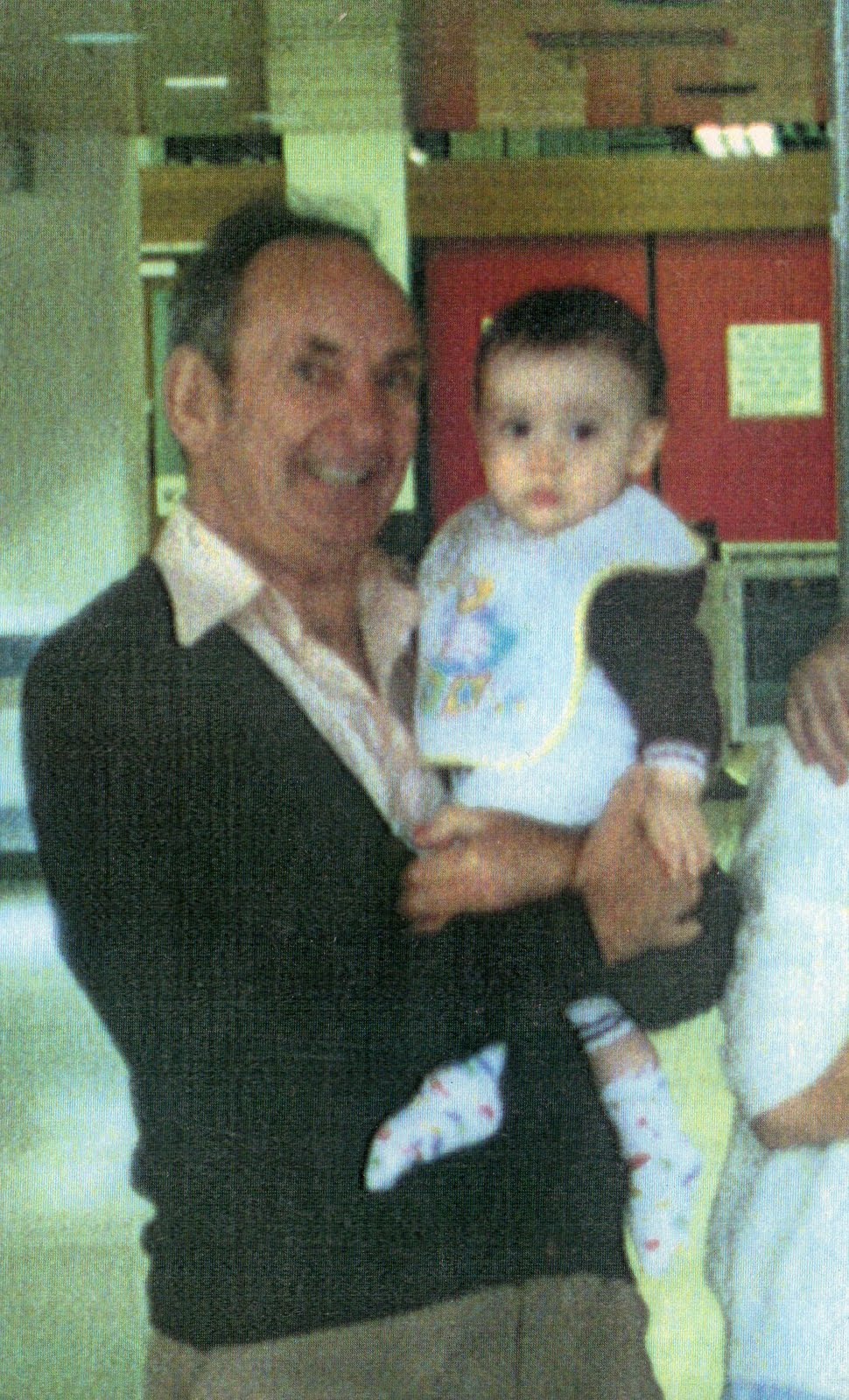 Since my office-locking weeping, and some counselling (both as part of my studies and something I felt necessary for myself) I had resolved to heal the wound that had been caused in my relationship with Dave. We arrived back in New Zealand in February, 1991. He, with the rest of my family, was at the airport to greet us. They all saw their grand-son (Matthew) for the first time, and this is the only photo I have of Dave with any of my boys. A few months later he died. The wound had not even begun to be healed.
There was no angry antagonism between us. It was not the kind of relationship where he was the cantankerous old git and I was the compliant little boy or the placater. To my memory, there was nothing. Which may be a bit harsh. I know he was around. He was involved in another long term relationship with a nice woman (nice until the meagre will became an issue). He drove me to work sometimes. He came to my wedding. He took me to Citizen’s Club picnics.
As to a “relationship” there wasn’t one. But even saying that sounds disrespectful. In recent years I have discovered that he, like so many of us, just simply did the best he could with what he had. As far as I know he wasn’t an abusive man. I don’t remember him ever hitting me or smacking me. He was educated, articulate. He seemed to lack ambition or drive. He enjoyed a smoke and a beer. Or two. He played snooker at the RSA or the Citizen’s Club.
One of the things I longed for was to go with him to play snooker at the Citz Club. In light of the fishing rebuff I was always reluctant to ask. Though the timing is vague, I do know that once before he died we spent the afternoon playing snooker at the Citizen’s Club in Rotorua.
Perhaps, instead of sitting down and rehashing the previous twenty years and the hurts and wounds, those games of snooker symbolised something at the time neither of us understood. Perhaps instead of hugging and crying and forgiving, we subconsciously let the years of aloneness slide away with every pot of every coloured ball. And in typical Kiwi man-style, we had a couple of beers and laughed.
I think I had decided to leave the heavy talk for another time, as surely it would eventually be necessary.
But that time never came. The next time I saw him he was dead in a box in a church.
I could wax lyrical about the need to seize the moment, but we do things in our own good time, and sometimes the timing doesn’t work. Whether via something specific like a game of snooker or a hug at the airport, or via some sub-conscious maturity that comes to us all, I feel Dave and I made up. Dave had done nothing for me to hate him, or even to disrespect him, so perhaps that made it easier for me to “forgive” him.
But I don’t know what the last twenty years would have been like had he lived. And I will probably never fully understand just what affect upon me Dave’s absence has had.
I find myself lacking ambition, and even motivation. I don’t make friends easily. I have an incredible tolerance for the “big” things, but I get angry quickly at little things (tangled cords and stupid things that don’t work as they “should”). Is that the legacy Dave left me, or some other inadequacy in me? Is it genetic? Learned? Or just a character flaw in me? Are my failed relationships (there have been many) due to some sense that I have no idea what it means to be a boyfriend/husband? Was I weak and bullied at school because I didn’t know what it really meant to be a man? Am I distant from my sons because I never learned to be a father?
Did I feel overcome while writing this (at the bit about scattering the ashes) because the wound will never really be healed and I’m simply fooling myself thinking I may have resolved my fatherlessness issues? Is such a deep wound ever healed?
So, it’s Father’s Day. Like birthdays and Christmas I really don’t make a big deal about it. Josh was excited to buy me presents and make me toast and coffee this morning and I loved it. Matt came over and despite our relative estranged-ness, I love him dearly and am immensely proud of him for the man he has become. Chris was called in to work (at McDonalds) last night at 11 to cover no-shows, worked all night and then his normal shift today. He has a pretty good work ethic and I’m proud of him too (even if he won’t tidy his room).

That’s probably all I need for Father’s Day…to have three wonderful sons (and a step-son in Wellington who is growing into a fine young man too). And lest anyone misjudge, I’m not really claiming much of the credit for any of it.
I don’t remember what Father’s Day was like when Dave was alive. Probably the perfunctory socks and underwear… or a cheap McKenzies tie or some smokes. I doubt I cared.
I’m reluctant to trace back some of the short-comings in my life and personality to a trauma experienced in the wake of my own fatherlessness, or the lack of an active role model. But can I ignore it? My life has taken a million turns. Would I have made better decisions if Dave had been more present and guided me? Would I have dealt with heartache and tragedy better if Dave’s arms had been available? Would I respect people more if he had encouraged me to do so, and rebuked me when I didn’t? Would I have had better relationships if he had showed me how it should be done?
 Who knows? I’m not blaming him for my mistakes, especially the ones I’ve made when I was old enough to know better. I’m just wondering how my life would be different now if this morning I could have called him and wished him a happy Father’s Day.
Subscribe to:
Posts (Atom)
